
Pack Rat Removal in Phoenix, AZ
Pack rats are the desert-edge animal rather than the attic animal, and the damage usually turns up as chewed wiring on a car or an air conditioner. Licensed Arizona contractors clear the middens, trap the animals and close what they were nesting in.
What pack rat removal in Phoenix covers
Pack rat removal is outdoor work: locating and clearing the middens, trapping the animals using them, and closing or protecting whatever they were nesting in or under. The University of Arizona Cooperative Extension states that exclusion and barriers are the most effective way to manage woodrats where they are getting into structures, and that is the spine of the job here too.
On a typical Valley lot the work starts at the perimeter and moves in. Whoever attends walks the block wall line, the shrub and cactus beds, the equipment pads, the shed, the side gate and anything parked or stored outdoors, then deals with the nests found before the traps go out. Clearing a midden without closing the spot it occupied invites the rebuild.
- A free walk of the yard, the wall line, the equipment pads and any outbuilding
- Middens located and removed, including material packed under shrubs, against wall corners and beneath equipment
- Trapping on the runs between the nest site and the food or water source
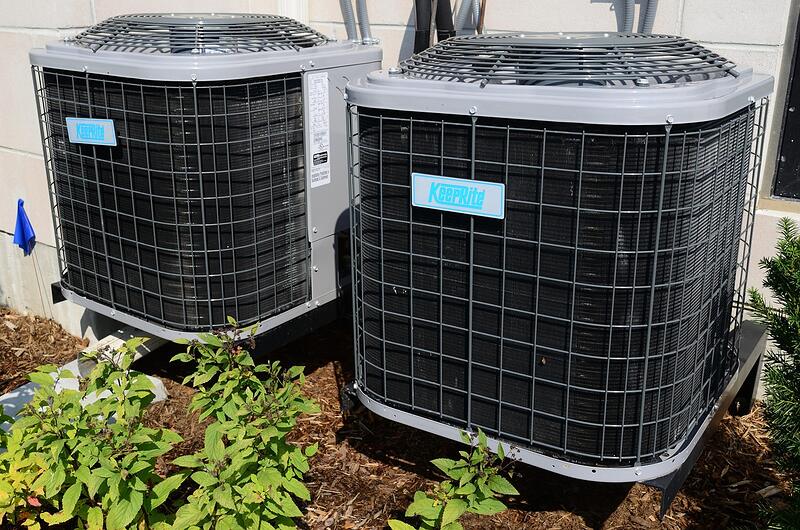
- Condenser units, pool equipment and irrigation controllers checked for gnawed wiring and nesting material
- Vehicles, trailers and stored equipment checked for nests and chewed harness shielding
- Sheds, block wall weep openings, garage door edges and gaps under gates closed or screened
- Advice on which plantings and stored material are holding the pressure in place
- A written record of the sites cleared and the openings closed
Where the noise is overhead and inside instead, the right page is roof rat removal. Attic-level openings still matter here, which is why the rodent exclusion page is usually quoted alongside.
What a pack rat is, and how to tell it from a roof rat
A pack rat is a woodrat, a native desert rodent with a fur-covered tail, and that tail is the quickest way to tell it apart from a roof rat. The University of Arizona Cooperative Extension describes woodrats as relatively large rodents with big eyes and ears, a fur-covered tail and a whitish underbelly and feet, and names three species found in central Arizona: the white-throated woodrat, the Mexican woodrat and Stephens woodrat.
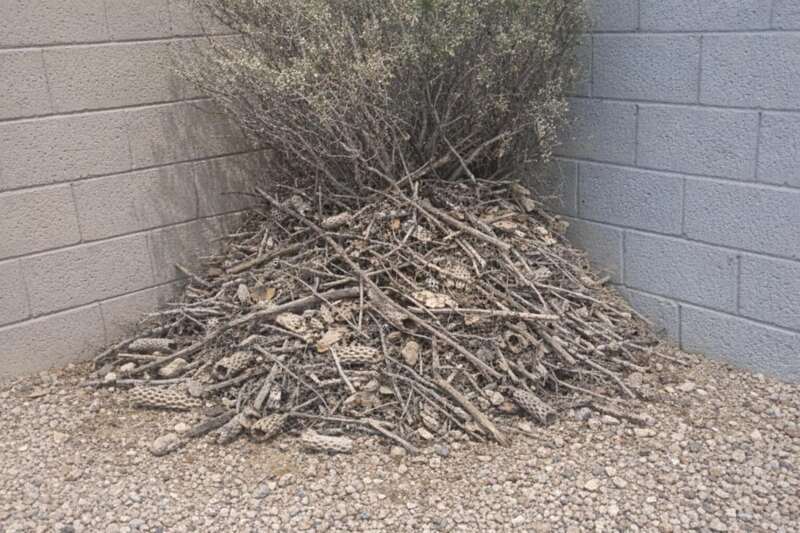
The habits are where the two animals diverge completely. A roof rat climbs and nests in attics; a woodrat builds on the ground and usually stays there. The extension describes the nest, called a midden, as a mound of vegetation and sticks built at the base of a prickly pear or a palo verde, with several entrances and exits, tunnels running a few inches below ground, rooms used for storage and grass-lined nests for sleeping. Around houses that same structure gets built against a block wall corner, under an oleander or a bougainvillea, inside a shed, beneath a condenser pad or under a vehicle that has not moved for a while.
They are nocturnal, and they collect. The extension notes their attraction to shiny or interesting objects, carried along until something more interesting turns up, which is where both the name packrat and the older name trade rat come from. Diet runs from cactus, juniper berries, acorns and pinyon nuts through to leaves, shoots, flowers, vegetables and fruit, and it is that last group that usually introduces a Phoenix household to them.
Why the damage shows up in a car or an air conditioner
Woodrats gnaw the vinyl and plastic shielding on electrical wire, and the University of Arizona Cooperative Extension notes they are notorious for chewing the wiring of cars and appliances. That is the single most expensive thing this animal does in the Valley, and it is why a pack rat problem often gets discovered at a repair shop rather than in the house.
The pattern is consistent. A vehicle parked on a gravel driveway or in an open carport for a week or two becomes shelter, the engine bay is warm and enclosed, and the harness shielding is exactly the material the animal works on. Outdoor condenser units sit on a pad against a wall with a gap underneath, which is ideal midden ground, and the low-voltage control wiring inside the cabinet is reachable. Pool equipment, irrigation valve boxes and landscape lighting transformers follow the same logic: enclosed, warm, wired and rarely opened.
What a site walk looks for is nesting material in those cabinets, droppings on a pad, chewed insulation on a harness, and the midden within a short walk of whichever piece of equipment is affected. Clearing the nest, trapping the animals and then screening or sealing the access under the pad, the shed and the wall is what stops the same repair bill arriving twice. UF/IFAS notes generally that rats chew wires and can potentially start fires, which is reason enough to have chewed material inspected properly rather than taped over.
Which parts of the Valley have pack rats
Pack rat pressure follows the desert edge, so it is a north and south Valley problem more than a central Phoenix one. North Phoenix, the Ahwatukee foothills against South Mountain, the Cave Creek side and north Scottsdale carry most of it, along with the desert-edge subdivisions generally.
The reason is landscape rather than house age. Those areas back onto open desert or a preserve, the washes run through or behind them, and the landscaping is gravel with cactus, palo verde, mesquite and low desert shrubs, which is the natural habitat the extension describes for these species. A subdivision built in the 1990s or 2000s with block walls, gravel yards and a wash behind it supplies cover, building material and food without anybody doing anything wrong.
Central Phoenix gets them too, in smaller numbers and usually where a lot has mature desert plantings or a long-neglected side yard. The older irrigated neighborhoods such as Arcadia and Willo lean the other way, toward roof rats in the attic, for the opposite reason: citrus, lawn, flood irrigation and tree canopy rather than gravel and cholla. Area pages under locations set out which animal dominates where.
What closing a lot against pack rats involves
Exclusion for pack rats is ground-level work, and the University of Arizona Cooperative Extension identifies exclusion and barriers as the most effective management where woodrats are entering structures, including sealing cracks and openings at attic level. The quarter-inch figure UF/IFAS gives as the rat-proofing standard applies here as well, since this is a rat-sized animal.
| Location | What a woodrat uses it for | How it gets closed |
|---|---|---|
| Gap under a condenser or pool equipment pad | Sheltered midden ground with warm wiring directly above | Hardware cloth skirted around the pad edge and pinned down, with the cabinet penetrations closed |
| Block wall weep openings and wall corners | Entry into the wall cavity and a protected corner to build against | Stainless or galvanized mesh fitted to the opening so drainage still works |
| Shed floor, shed door and skids | The most common built midden site on a suburban lot | Door sweep and frame repair, mesh skirt around the base, floor gaps closed |
| Garage door bottom and side edges | A direct route into a garage with stored material in it | New bottom seal, side seals and threshold, and the gap over the attic access panel closed |
| Gaps under gates and along fence lines | Travel route between the wash or the wall and the equipment | Gate bottom closed, mesh buried along the run where the traffic is |
| Dense shrub and cactus beds against the house | Cover, building material and food in one place | Thinned and lifted rather than removed, so the ground underneath is open to view |
| Stored lumber, pots, pavers and firewood | Instant midden material and cover | Raised off the ground and moved away from the wall line |
Attic-level sealing still belongs on the quote where a wall or a roof is involved, and on a tile roof that means the bird stop along the eave. The rodent exclusion page covers that side in full.
What pack rat work costs in Phoenix
Pack rat jobs are priced from the site rather than from a table, because the variable is how many middens there are and what they are built into. The published bands still set the frame: Angi puts a Phoenix rat extermination visit at $144 to $443, averaging about $286, with follow-up visits at $50 to $150 and exclusion work such as screening vents and repairing holes at $200 to $600.
| Line item | Band | Source |
|---|---|---|
| Site inspection | Free here | $0 to $175 standalone, HomeGuide 2026 national |
| Trapping visit | $144 to $443, averaging about $286 | Angi cost data, Phoenix |
| Follow-up visits | $50 to $150 each | Angi cost data, Phoenix |
| Screening and repair of named openings | $200 to $600 | Angi cost data, Phoenix |
| Whole-shell exclusion where the house is involved | $500 to $2,500 | HomeGuide 2026 national |
| Midden clearance and cleanup | Quoted from the site | Cleanup and decontamination $600 to $2,500 nationally, HomeGuide 2026 |
A single midden under one shrub beside a wall, with no equipment damage, is the cheapest job on this list. An acre lot with four middens, a shed built on skids, two vehicles with chewed harness shielding and a condenser full of nesting material is several visits and sits well above the single-visit band. Vehicle and appliance repair is not part of a pest quote and belongs with a mechanic or an HVAC contractor; what a rodent contractor can do is remove the cause and close the access.
The licensing and wildlife position in Arizona
Woodrats carry no legal protection in Arizona, and the University of Arizona Cooperative Extension states that homeowners may put control measures in place without contacting wildlife officials first. That is a useful thing to know, because it removes a step people often assume exists.
The licensing question is separate and does apply. Structural pest control in Arizona is licensed by the Arizona Department of Agriculture, Pest Management Division, and the license trigger reaches as far as making site-specific recommendations and offering to perform pest control work. A PMD licensee may remove nuisance rodent species without holding a separate wildlife service license from Arizona Game and Fish, which is why one contractor can clear a midden in a shed and close an attic-level opening on the same visit.
Every contractor routed from here carries the PMD license the work requires. Ask for the business license number, verify it with the PMD before anything starts, and ask for proof of insurance in the same conversation, particularly where work is happening around electrical equipment. Nothing written on this page is a treatment recommendation for your own property, which is a judgment for the licensed contractor standing on the lot.
The services that usually sit beside this one
Pack rat work runs outside in rather than top down, and these are the pages that cover the pieces around it.
- Rodent Exclusion: Closing the shell: tile eaves, vents, conduit sleeves, weep screed and garage edges.
- Rodent Inspection: A free walk of the roofline, attic and perimeter that fixes the order of the job.
- Roof Rat Removal: Trapping out the climber that dominates Valley attic calls, run alongside the sealing.
- Commercial Rodent Control: Restaurants, warehouses, multifamily and retail, with documentation that survives an audit.
A lot with both a midden outside and activity in the ceiling needs two of these at once, which the free inspection sorts out. The about page covers who turns up.
Working a pack rat problem
Four stages, and why the nest matters.
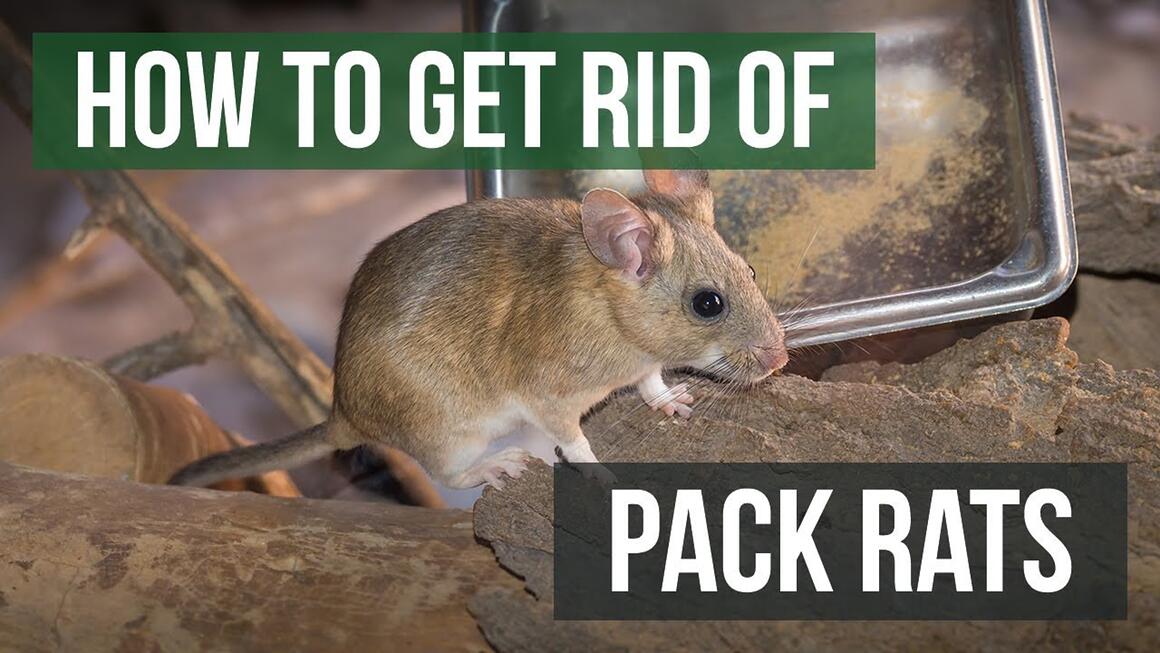
Video: How to Get Rid of Pack Rats and Woodrats, from Solutions Pest & Lawn.
How a pack rat job runs on a Valley lot
Five steps, working from the perimeter inward, because the midden rather than the house is the thing to deal with first.
-
Describe what you are finding
Where the sticks are piling up, what has been chewed, whether a vehicle or an air conditioner is involved, and how long it has been building. That separates a woodrat from a roof rat before anybody drives out.
-
Walk the lot
The wall line, the shrub and cactus beds, the equipment pads, the shed, the gates and anything parked or stored get checked, and every nest site goes on a written list.
-
Clear the middens
Material is removed from under shrubs, wall corners, shed floors and equipment pads, which takes away both the shelter and the stockpile at the same time.
-
Trap the runs
Traps go on the routes between the cleared sites and the food or water, and are checked and reset rather than left in place untended.
-
Close the sites and protect the wiring
Mesh skirts, door seals, wall weep screens and cabinet closures go in, and any chewed harness or control wiring is flagged for the right trade to repair.
What to expect
Pack rat visits follow this order on every lot, whatever the nest turns out to be built into.
- A walk of the full perimeter before anything is priced
- Nest sites photographed and listed rather than just cleared
- Equipment cabinets opened and checked for nesting material
- Traps set on the travel routes and reset on each visit
- A list of the sites cleared and the openings closed
Why Valley property owners route pack rat work through us
Three things separate a cleared midden from a cleared problem.
-
Exclusion is treated as the main event
The University of Arizona Cooperative Extension identifies exclusion and barriers as the most effective management where woodrats are entering structures, and a job routed from here is quoted that way: mesh skirts at equipment pads, screens in block wall weep openings, a real seal on a shed door, the garage edge closed. Clearing a midden on its own leaves the site available and the building material lying around, which is why the mound is usually back within a season.
Exclusion and barriers are the most effective management, University of Arizona Cooperative Extension
-
The wiring gets looked at as well as the nest
The extension notes woodrats gnaw the vinyl and plastic shielding on electrical wire and are notorious for chewing the wiring of cars and appliances, so a site walk opens the condenser cabinet, checks the pool and irrigation controllers and looks into the engine bay of anything parked on gravel. Finding chewed insulation during a pest visit is cheaper than finding it when the air conditioning stops in June, and the repair gets flagged to the right trade rather than taped over.
Woodrats are notorious for chewing the wiring of cars and appliances, University of Arizona Cooperative Extension
-
A desert lot is read as a desert lot
Gravel, cholla, palo verde and a wash behind the wall are the habitat these species belong in, so the job is about where the cover and the building material sit rather than about spraying a perimeter. Thinning and lifting shrubs so the ground underneath is visible, getting stored pavers and firewood up off the gravel, and closing the gap under a shed do more than any product, and that is what the inspection report says.
Middens are built of vegetation and sticks at the base of cactus and palo verde, University of Arizona Cooperative Extension
What Reddit Says About Pack Rat Removal in Phoenix
Homeowner threads on rodent work give the same advice whichever animal is involved, and on outdoor rats the cost-of-damage thread is the loud one. People describe finding the problem through a repair bill rather than through a noise, and they warn each other that clearing a nest without closing the site it occupied buys a few months at most. The recommendation is always several bids for identical scope, because a single number cannot be judged against anything.
The red flags translate directly. A plan that is only bait and no barrier draws the same criticism here as in an attic thread. Quotes that bundle a recurring monitoring fee into the removal price get flagged every time. Companies that keep coming back month after month with the results unchanged are the other recurring complaint, and the pattern described is almost always trapping or baiting with no physical work done at all.
The questions people tell each other to ask are the useful output. What exactly is included, and what is a separate line item? Does the company do the physical sealing work itself or refer that to somebody else? How many follow-up visits sit inside the quoted price? Is the exclusion work warrantied, and for how long? Will anything be cleaned up, or only trapped? Timelines in the corpus run longer than anybody expects, and expecting two or three visits rather than one is realistic.
Those threads are roughly why this page leads with the barrier work rather than the trap count, and why the quote keeps clearance, trapping and sealing on separate lines.
A typical pack rat job on a desert-edge lot
The situation: A north Phoenix house backing onto a wash, gravel yard, a bed of prickly pear and bougainvillea along the side wall, and a pickup that sits on the driveway most of the week. The air conditioning started cutting out in May, the repair technician found nesting material and chewed low-voltage wiring inside the condenser cabinet, and the homeowner has since noticed a mound of sticks and cholla joints built up in the corner where the block walls meet.
What gets done: The lot walk finds two middens, the one in the wall corner and a second under the prickly pear, plus droppings on the condenser pad and a nest started behind the pool equipment. Both mounds are cleared, traps go on the run between the wall corner and the equipment pads, and the pickup engine bay is checked and found clean. On the second visit the condenser and pool pads are skirted with hardware cloth pinned at the gravel line, two block wall weep openings are screened, the side gate gets its bottom gap closed, and the bougainvillea is thinned so the ground beneath it is visible.
How it turns out: Three animals over the first ten days and nothing after that. The third visit finds no new material at either site. The HVAC repair is handled separately by the homeowner's own contractor, and the written record lists both middens, the screened weep openings, the two pad skirts and the gate. The stored pavers along the wall get moved off the gravel on the contractor's recommendation.
Pack rat questions from Phoenix callers
What people ask once they have worked out the problem is outdoors rather than in the attic.
How do I know if it is a pack rat or a roof rat?
Look at the tail and at where the nest is. The University of Arizona Cooperative Extension describes a woodrat as a relatively large rodent with big eyes and ears, a fur-covered tail and a whitish underbelly and feet, while a roof rat has a bare scaly tail longer than its head and body. Then look at behavior: a mound of sticks and cholla on the ground is a woodrat, and running across a ceiling after dark is a roof rat, which Maricopa County Vector Control reports spends about ninety percent of its life four feet or more off the ground.
What is a midden?
It is the nest. The University of Arizona Cooperative Extension describes it as a mound of vegetation and sticks built at the base of a prickly pear or a palo verde, with several entrances and exits, tunnels running a few inches below ground, rooms used for storage and grass-lined nests for sleeping. Around a Phoenix house the same structure turns up against a block wall corner, under a dense shrub, inside a shed, beneath a condenser pad or under a vehicle that has not been moved.
Why is my stuff ending up in the nest?
Because they collect. The extension notes woodrats are attracted to shiny or interesting objects and will carry one until something more interesting turns up, which is where the names packrat and trade rat come from. Finding bottle caps, screws, bits of foil, a dog toy or a missing set of keys worked into a mound is ordinary, and it is a reliable way of confirming which animal you are dealing with.
Will they chew my car wiring?
It is the most common expensive damage they do. The University of Arizona Cooperative Extension notes woodrats gnaw the vinyl or plastic shielding on electrical wires and are notorious for chewing the wiring of cars and appliances. A vehicle parked on gravel for a week or two is shelter, and the engine bay is warm and enclosed. Outdoor air conditioning condensers, pool equipment, irrigation valve boxes and landscape lighting transformers get the same treatment for the same reason.
Do I need a permit or a wildlife license to remove them?
No. The University of Arizona Cooperative Extension states that woodrats are not legally protected in Arizona, so a homeowner can put control measures in place without contacting wildlife officials first. The license that does apply is the contractor's: structural pest control in Arizona requires a license from the Arizona Department of Agriculture, Pest Management Division, and a PMD licensee may remove nuisance rodents without a separate wildlife service license from Arizona Game and Fish.
If I clear the nest myself, will they come back?
Usually, unless the site is closed afterward. The mound is the visible part; the reason it was built in that spot is cover, a gap to build against and material lying within reach, and all three survive the clearance. The extension names exclusion and barriers as the most effective management where woodrats are entering structures, which in practice means a mesh skirt at an equipment pad, screens in block wall weep openings, a real seal on a shed door and stored material lifted off the gravel.
Is this a summer problem or a winter problem?
Both, with a shift in where it shows up. Valley winters are mild enough that rodent pressure never really stops, and while attic calls about roof rats peak roughly October through March, pack rat calls tilt toward the warm months when the nesting around condenser units, pool equipment and parked vehicles gets noticed. A midden built in March is usually discovered in June when the air conditioning starts behaving oddly.