Rodent Removal in Desert Ridge
Desert Ridge is newer stock on the desert edge, which puts pack rats ahead of roof rats on most of these streets. A licensed contractor walks the yard, the wall line and the roof at no charge.
Newer houses, and a different list of openings
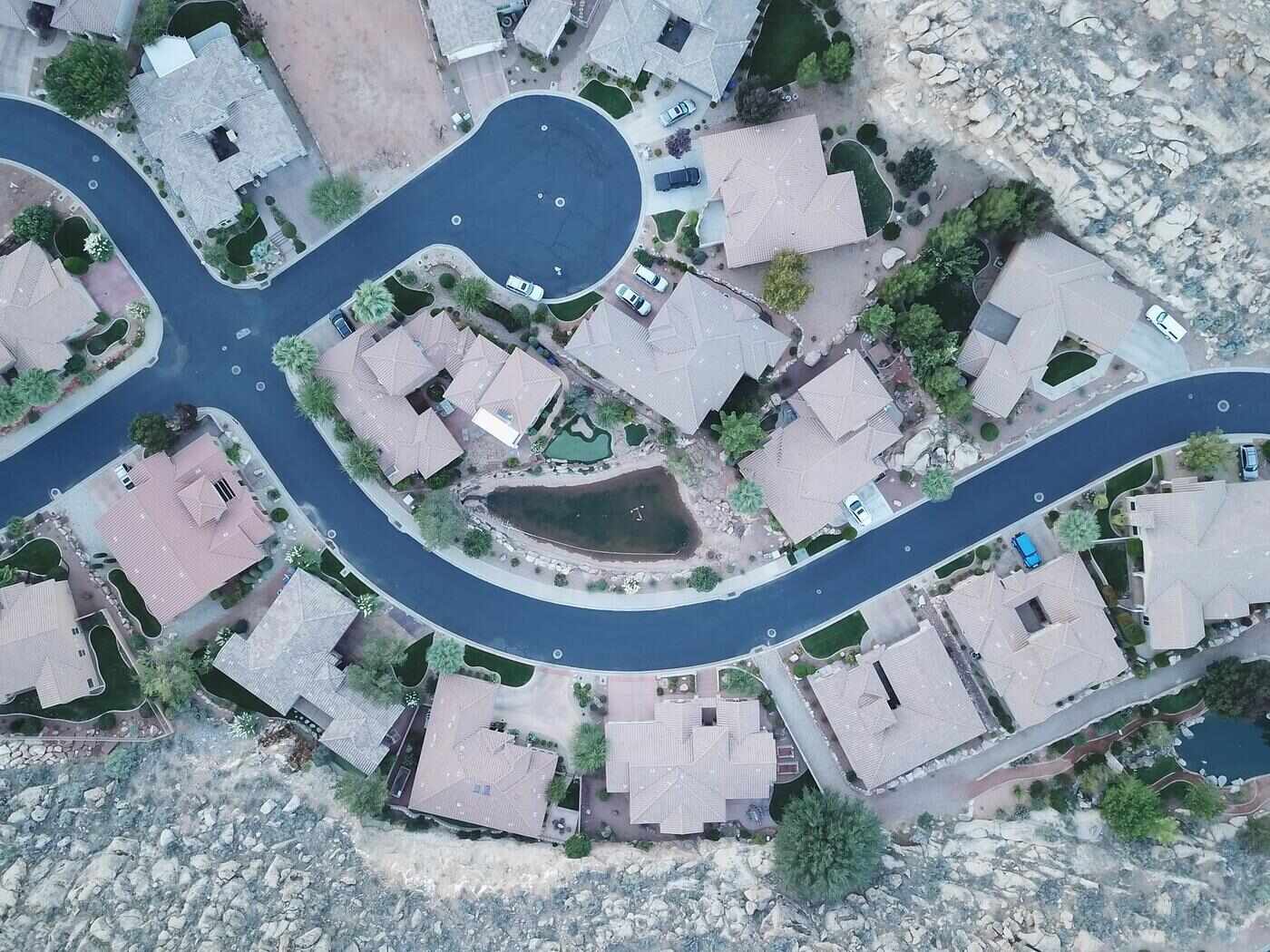
Desert Ridge is largely master-planned development from the 1990s onward, block and stucco under concrete or clay tile, with gravel and desert landscaping and block walls between lots. Houses of that age have an advantage over older Phoenix stock and one specific vulnerability, and knowing which is which saves a good deal of argument.
The advantage is that the vents, the penetrations and the weep screed were detailed to relatively modern practice and are often still sound. The vulnerability is the first course of tile: mortar bird stops crack out after roughly fifteen to twenty years of Valley sun, which means houses built in the late 1990s and early 2000s are now exactly at the age where that opening appears. A house can be twenty years old, immaculate, with nothing growing near it, and have a continuous void running the length of the eave.
The rest of the list on this stock is short: gable and soffit vents, the sleeve where the air conditioning line set passes through the block, the garage door edges where the slab has dipped, and the weep openings in the block walls. Rodent exclusion sets out what the closure work involves and how it gets measured.
On these streets the pack rat comes first
North Phoenix development sits against open desert and is cut through by washes, and on a gravel lot with cactus and palo verde the animal you are most likely to meet is a woodrat rather than a roof rat. That is a genuine difference from central Phoenix and it changes where the work happens.
The University of Arizona Cooperative Extension names three woodrat species found in central Arizona, the white-throated woodrat, the Mexican woodrat and Stephens woodrat, and describes the nest, called a midden, as a mound of vegetation and sticks built at the base of a prickly pear or a palo verde, with several entrances and exits, tunnels running a few inches below ground, rooms used for storage and grass-lined nests for sleeping. On a Desert Ridge lot the same structure gets built against a block wall corner, under a shrub, inside a shed, beneath a condenser pad or under a car that has been parked for two weeks.
They also collect, which is how many households confirm the diagnosis. The extension notes woodrats are attracted to shiny or interesting objects and carry one until something more interesting appears, which is where the names packrat and trade rat come from. Finding bottle caps, screws, foil, a dog toy or a missing set of keys worked into a mound is ordinary. Pack rat removal covers the work.
Washes and retention areas are the travel network
Master-planned north Phoenix is laid out around washes, retention basins and landscaped corridors, and those features are continuous habitat running between subdivisions. A wash behind a back wall is brush, shade and cover along its whole length, and a retention basin is a landscaped island with water available on a schedule.
For a homeowner that means the pressure is structural to the location rather than a consequence of anything on the lot, and it is permanent. Nothing done to a wash will change it, and nothing needs to: what changes the outcome is whether the specific sites on your own property are available. The University of Arizona Cooperative Extension identifies exclusion and barriers as the most effective management where woodrats are getting into structures.
In practice the items that matter are the gap under a condenser or pool equipment pad, the weep openings along a block wall, the bottom of a shed door or side gate, stored pavers and firewood sitting on gravel, and shrub beds dense enough that the ground beneath them cannot be seen. Those are small corrections rather than a landscaping project, and they are what a report on a Desert Ridge lot should lead with.
Wiring on equipment and vehicles is the expensive part
The costly damage out here is electrical. The University of Arizona Cooperative Extension notes woodrats gnaw the vinyl and plastic shielding on electrical wire and are notorious for chewing the wiring of cars and appliances, and on a newer north Phoenix lot that means a condenser unit, a pool pump, an irrigation controller, landscape lighting or a vehicle on the driveway.
All of those share the same qualities: enclosed, warm, wired, and opened perhaps twice a year. An outdoor condenser sits on a pad against a wall with a gap beneath it, which is ideal midden ground, and the low-voltage control wiring in the cabinet is within reach. A car or trailer parked on gravel for a couple of weeks becomes shelter with a warm engine bay.
A site walk here opens those cabinets rather than looking at them, because nesting material or chewed insulation inside one is both the diagnosis and the reason to act now rather than in July. Wiring repairs belong to an electrician or an air conditioning contractor; the rodent contractor's part is to find it, record it with a date, and close the access so the same repair is not needed a second time.
A representative Desert Ridge wall and pad closure
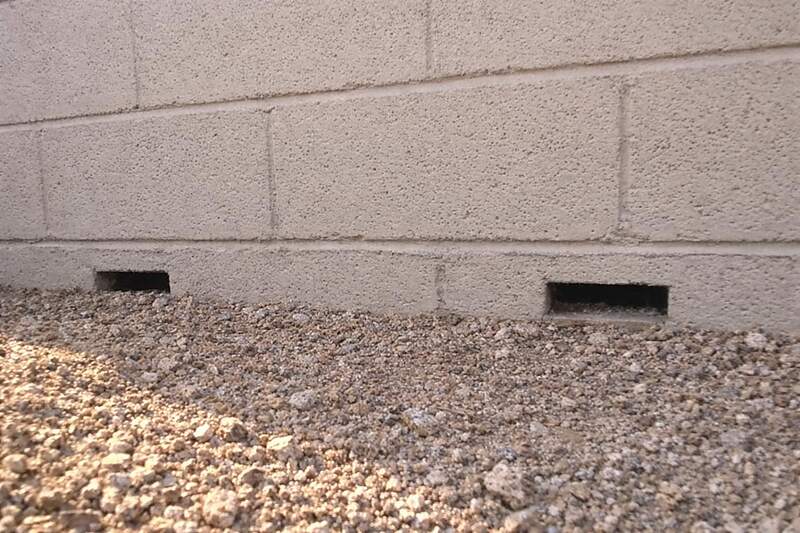
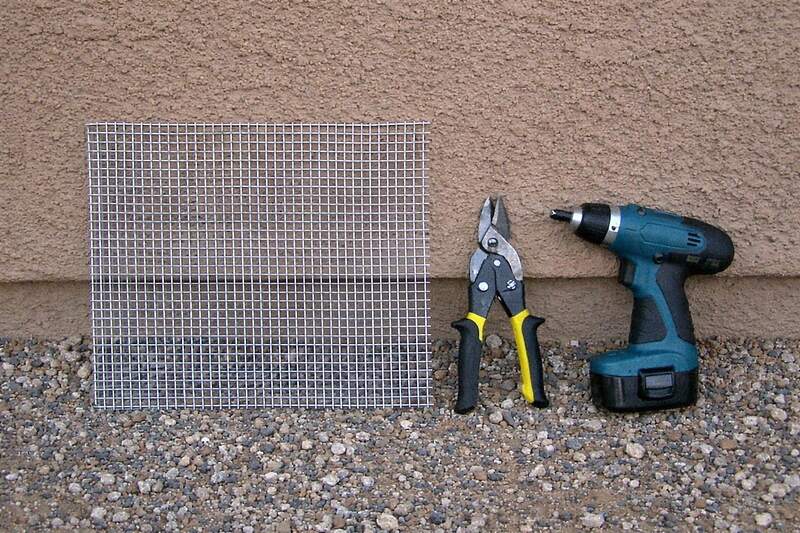
The characteristic closure on a north Phoenix lot is at ground level: hardware cloth skirted around an equipment pad and pinned at the gravel line, mesh fitted into block wall weep openings so drainage still works, a proper bottom seal on a shed door, and the gap under a side gate closed. None of it is exotic and all of it holds.
The roof half is the specification this stock needs at its current age: a manufactured metal bird stop along the measured first course of tile, quarter-inch galvanized cloth at the gable and soffit vents, and a metal collar with mortar at the line set sleeve. On a lot right against a wash the ground-level items usually carry more of the quote than the roof does.
The image is representative rather than a specific job. The record handed over afterward lists each site cleared, each opening closed and the material used at it, which on equipment pads also documents the condition of the wiring at that date.
Why mice keep coming back
A look at the openings that make it repeat.

Video: EASY WAY to Get Rid of Mice in Your House FOREVER, from Silver Cymbal.
Why Desert Ridge homeowners book through us
Three things a newer desert-edge lot needs.
-
Ground level comes before the roof
On a gravel lot backing onto desert or a wash, the nest is usually a midden rather than an attic, so the survey leads with the wall line, the shrub beds, the equipment pads, the shed and anything parked. The University of Arizona Cooperative Extension names exclusion and barriers as the most effective management where woodrats are entering structures, which makes the mesh skirt and the wall weep screen the main event rather than an add-on.
Exclusion and barriers are the most effective management, University of Arizona Cooperative Extension
-
A twenty-year-old roof gets measured anyway
Houses built in the late 1990s and early 2000s are now at the age where mortar bird stops have cracked out of the first course of tile, after roughly fifteen to twenty years of sun, so a newer house is not a closed house. The eave gets walked and measured in feet, and bird stopping appears in Department of Energy guidance as a recommended measure for clay and concrete tile roofs. A quote that skips the eave because the house is recent has skipped the likeliest opening.
Bird stopping is recommended for clay and concrete tile roofs, US Department of Energy
-
Equipment cabinets get opened and dated
The extension notes woodrats gnaw the vinyl and plastic shielding on electrical wire and are notorious for chewing the wiring of cars and appliances, and the condenser, the pool pump, the irrigation controller and a car on gravel are all enclosed, warm and rarely checked. A walk here opens them, records what is inside with a date, and refers any wiring repair to the right trade rather than writing it off as somebody else's discovery in July.
Woodrats are notorious for chewing the wiring of cars and appliances, University of Arizona Cooperative Extension
A common Desert Ridge call
The situation: A 2003 two-story house on a north Phoenix street with a wash running behind the back wall, gravel yard, prickly pear and palo verde in the side beds, a travel trailer parked on the side slab most of the year. The owners had found a mound of sticks and cholla joints against the back wall corner in March and cleared it themselves. By June it was back, larger, and the landscape lighting on that side of the house had stopped working.
What gets done: The lot walk finds the rebuilt midden at the wall corner, a second under the palo verde, nesting material inside the landscape lighting transformer box with the low-voltage run chewed through, and droppings on the condenser pad. Both mounds are cleared and traps go on the run between them. The trailer is checked and a nest is found under it with no wiring damage yet. On the second visit the condenser pad is skirted in hardware cloth pinned at the gravel line, the transformer box is closed and the run flagged for an electrician, four wall weep openings are screened, and the palo verde bed is thinned so the ground beneath is visible. The roof is walked and the first-course closures turn out to be gone along about twenty feet of the rear eave, which is closed with a metal bird stop on a third visit.
How it turns out: Four animals across two weeks, then nothing at either site. The lighting is repaired separately by an electrician. The record lists both middens, the trailer nest, the pad skirt, four weep screens, twenty-one feet of bird stop and the transformer box, with the date the chewed run was found. The owners move the stored pavers off the gravel and park the trailer on the street when it is not in use.
Desert Ridge questions
What callers from the newer north Phoenix streets ask first.
Is this a pack rat or a roof rat?
On these streets it is more often a pack rat. A mound of sticks and cholla against a block wall, under a shrub, in a shed or beneath a parked vehicle is a woodrat, which the University of Arizona Cooperative Extension describes as a large rodent with big eyes and ears, a fur-covered tail and a whitish underbelly and feet. Running across a ceiling after dark is a roof rat, reported by Maricopa County Vector Control as spending around ninety percent of its life four feet or more above the ground. Chewed wiring on a car, a condenser or a lighting transformer points hard at the woodrat.
I cleared the nest myself and it came back. Why?
Because the site is still available. The mound is the visible part, and the reasons it was built there, cover, a gap to build against and material lying within reach, all survive the clearance. The University of Arizona Cooperative Extension names exclusion and barriers as the most effective management where woodrats are getting into structures, which in practice means a mesh skirt at an equipment pad, screens in the wall weep openings, a real seal on a shed door and stored material lifted off the gravel.
My house is only twenty years old. Does the roof still need checking?
Yes, and twenty years is close to exactly the age when it matters. The original mortar closures in the first course of tile crack out after roughly fifteen to twenty years of Valley sun, so a house built around the turn of the century is now at the point where a continuous void can be running the length of the eave. Nothing about that is visible from the ground, which is why the ladder comes out even on houses where the owner is certain the roof is fine.
Does the wash behind us mean this will keep happening?
The pressure is permanent; the access is not. A wash is continuous brush and cover running between subdivisions, so the animals are a feature of the location rather than a consequence of anything you have done, and nothing done to the wash will change that. What changes is whether the specific sites on your lot are usable: the pad gaps, the wall weep openings, the shed door, the gate bottom, dense beds and stored material on gravel. Close those and the wash stops mattering to your house.